English Club, RSL, and SAGA bring Banned Books to Campus
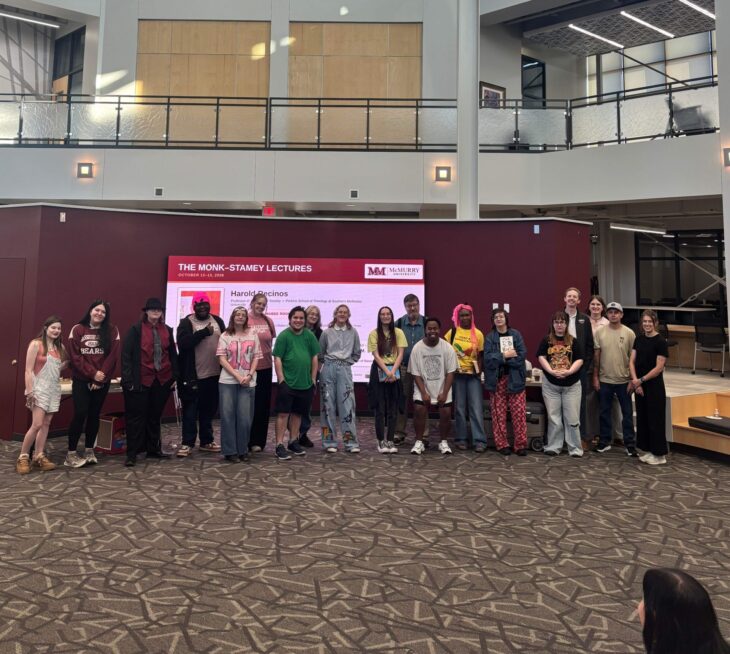
On October 8th, McMurry University’s English Club hosted its annual Banned Book Reading and book giveaway at 5:30 PM in the Student Center during Banned Book Week. Similar to last year’s event, English Club partnered with Sexuality and Gender Acceptance (SAGA) and Religious and Spiritual Life (RSL).
Readers, writers, and other creative minds have celebrated Banned Book Week since 1982. Banned Book Week began in response to a sudden surge in challenged books in libraries, schools, and even bookstores. To this day, Banned Book Week is celebrated to stand against censorship of literature at the local or academic level.
Elijah Lewis, a Junior Graphic Design and English student, serves as the English Club’s Secretary and Storyteller. Being the storyteller, it is only fitting that he is the main planner of the event! When asked if he believed censorship would be okay in any situation, Lewis said no because it would lead to “a never-ending censorship cycle,” meaning if one thing is allowed to be censored, no matter the intent, it opens the possibility for more censorship.
I was curious to know how each of the readers was chosen and why they chose the books they did. At the event, there were seven volunteer readers composed of students and faculty. Each volunteer was allowed to choose any book as long as it was banned at either a local or federal level. It was obvious from listening to the readers that many of the topics were very personal to them. For example, Lewis read the book “Red, White, and Royal Blue” by Casey McQuiston, and he cited it as the first queer book he read before coming out as trans to his family.
As Lewis mentioned at the event, minorities such as the LGBTQ+ community and religious groups are a common target for censorship, which is a big reason why it was so important to partner with SAGA and RSL. Diego Baez read the non-canonical Christian text, “Infancy Gospel of Thomas,” on behalf of RSL. After the reading, I took it upon myself to research the text and found out that it was rejected by the early church because they felt Young Jesus was not depicted with enough piety. Although this is true, it also depicts the benevolent acts of Young Jesus and attempts to understand the moral development of the Son of God. Although I understand why the text was not included in the New Testament, I found it very moving to be able to hear of Jesus’s boyhood in comparison to the Holy Son of God that we praise today.
In fact, when asked what the main takeaways he wanted attendees to come away with, Elijah answered, saying, “Banned books can come from all types of different forms. When we think of banned books, we mainly think of queer books, and while that is very true, those aren’t the only books that are targeted for censorship.” This became apparent throughout the event as beloved titles and many high school classroom favorites such as “The Hunger Games” and “The Picture of Dorian Gray” were read from for having upsetting and violent themes. Lewis ended the interview with the statement, “reading these books and supporting them are important to show that we believe these stories and voices are important to read and to learn from.”
Although the book ban reading has passed, be on the lookout for English Club’s Bake Sale on October 22nd and their annual Halloween party and writing contest called Gothicon, October 30th! If you are interested in joining or learning more about this amazing group, they meet in Old Maine 103 every Thursday at 5:30 PM!
Views expressed in this article are not representative of the Herald or McMurry University.